Quote

"For like a shaft, clear and cold, the thought pierced him that in the end the Shadow was only a small and passing thing: there was light and high beauty for ever beyond its reach." -- J.R.R. Tolkien

Wednesday, November 19, 2014

Currency, Quantitative Easing, and the real economy

I found an incredibly informative, if a bit technical, article on why currency manipulations and quantitative easing are not productive to the greater economy.  The real economy is driven by money changing hands.  The rate at which money changes hands is measured by a quantity called velocity.  The nominal GDP and the monetary base are the primary way economists measure velocity on a macro level.

The reason, John Hussman states, that quantitative easing and other currency-related manipulations are not more effective on the economy is that they do not increase the velocity of money flowing around the economy.

He states (in Losing Velocity: QE and the Massive Speculative Carry Trade):
From a monetary perspective, it’s easy to understand why replacing Treasury securities with zero-interest money (currency and bank reserves) does little to “stimulate” the economy. We may wish to believe that putting more zero-interest money into the economy would lead people to go out and spend those idle balances, but that imagines some fixed ratio between economic activity and the amount of money outstanding. That’s the error. The velocity of money (nominal GDP / monetary base) isn’t fixed at all. What happens in practice is that as the Fed creates more zero-interest money, holders try to get rid of it by buying financial assets that provide a higher potential return – driving prices up and expected future returns down until they are indifferent between an overpriced financial asset and zero-interest money. The closest alternative to currency is Treasury bills. So as the Fed creates more zero interest money, investors bid up Treasury bills, which lowers their interest rate. That’s how Fed actions move short-term yields.
As the central bank creates more money and interest rates move lower, people don’t suddenly go out and consume goods and services, they simply reach for yield in more and more speculative assets such as mortgage debt, and junk debt, and equities. Consumers don’t consume just because their assets have taken a different form. Businesses don’t invest just because their assets have taken a different form. The only activities that are stimulated by zero interest rates are those where interest rates are the primary cost of doing business: financial transactions.
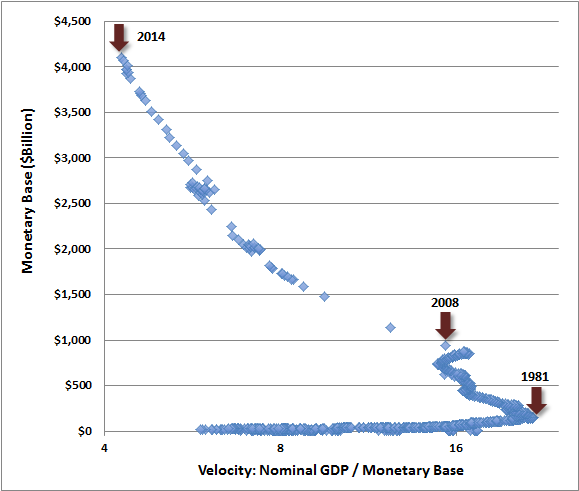
He also has included several charts, one of which compellingly exhibits this truth, compiled from Federal Reserve data compiled over the past century (or so).


As you can clearly see, the velocity of money around the economy, which is a fundamental factor in real economic growth, is at historic lows.  The relationship between the the zero-interest base money and the return potential made available by the higher interest investments is a primary driver in the velocity of money, and therefore, real economic growth.

Sadly, I doubt the Fed will choose to see or acknowledge this analysis enough to actually change course and perhaps aid the ailing economy that we find ourselves mired within.

Friday, November 7, 2014

Capitalism Around the World


My friend Gega found this here:
http://www.tickld.com/x/capitalism-explained-this-is-so-accurate-it-hurts

No Commerce without Government Sanction: The People's Republic of San Francisco

In the fascist age of America, the government in San Francisco is now telling people how they can and cannot use their own private property when conducting safe and publicly amenable business.  If I had the time and money, I would be inclined to purchase property there just to use it to break the law.

This is not Nazi Germany, fools, it is America.  The government of San Francisco apparently doesn't see the distinction.

Thursday, October 30, 2014

Marin Katusa: The Colder War

John Mauldin sent forward a subset of a new book coming out by Marin Katusa regarding Vladimir Putin's rise to power and his plan for Russia.

As the section below indicates, Putin's primary hold on power is via control of the Russian and global energy markets.  Putin is not one to be underestimated.  He is a brilliant politician, and an extremely capable leader.  He is the diametrical opposite of our current leader.

However, I imagine that even Putin did not see the hydraulic fracturing revolution coming, and I bet that it could very well be his undoing, if the U.S. has the foresight to capitalize on it before the technology is replicated elsewhere.  Sadly, we are mired down in a self-defecating push for green energy, thereby probably passing on our one chance to slow Putin down.

Either way though, this book is exactly up my alley of interest and I am going to buy it.  Besides, it is only 22 USD!

GamerGate: What?

As a gamer and now a game developer, I have to say that this whole GamerGate nonsense, which I just learned about today, is absurdity.

If you are as clueless as I was about this yesterday, here is the most neutral source I could find when I was asking what happened: http://knowyourmeme.com/memes/events/gamergate

However, since I wish to reaffirm the ethical foundation of an art that I both support and engage in, I will say two things.

First, sending death threats to anyone is not a terribly civil way to live, and I condemn this behavior strongly.  This is not how gamers behave and not how civil human beings behave.   If you are pretending to be ISIS, stop it.  It is not becoming of anyone in Western civilization to stoop to such barbary.  And for the love of all that is good, if you are going to threaten someone with death, have the honor to do it face to face, not like some coward hiding behind the anonymity of the internet.

Second, sleeping around in general is not a good thing.  Using that to gain advantage in a competitive capitalistic environment is equally unethical and deplorable.  Sex is meant, by design, to be exercised in the structural confines of marriage between and man and a woman for the purposes of propagating the human race.  It is shameful that people use each other in such a flippant fashion.  It hurts everyone involved and it is disrespectful to do that to another person.

Sadly, we live in a corrupt and wicked world in which no one really cares one whit about anyone else and most people will use anyone to get what they want, when they want it.  Any shreds of honor, civility, and humanity are gone from this age, which is ironic since those are the very principles that everyone loves to tout...  God forbid if they should actually have to live by them.


Thursday, October 23, 2014

John Pavolitz: Faith and Doubt

I found a marvelous blog article written by a pastor that addresses the fine line between faith and doubt and the interweaving of the two into the chaotic masterpiece of life that each of us lives.

This article also details, in very frank language, a very real problem in the Christian church today.  We pretend.  We act.  A lot more than we are called to.

God calls us to BE holy, NOT pretend to be holy.  Will we fail?  Absolutely.  That is where grace comes in, to forgive us of our failings and to empower us to change for the better.  How much can you fail before you are not considered a Christian?  Ten times?  One hundred?  Thousands?   How grievous of a sin can we commit repetitively and still be forgiven?  If the Bible is to be believed, an infinite number.  As Spurgeon has said:
Would not this be a great slur cast upon the grace of God? Suppose I could find out a sinner so vile that Jesus Christ could not reach him; why then the devils in hell would take him through their streets as a trophy; they would say, "This man was more than a match for God; his sin was too great for God's grace." What says the Apostle? "Where sin abounded"—that is you, poor sinner;—"where sin abounded"—what sins you plunged into last night, and on other black occasions,—"where sin abounded"—what? Condemnation? Hopeless despair? No, "Where sin abounded grace did much more abound." I think I see the conflict in the great arena of the universe. Man piles a mountain of sin, but God will match it, and he upheaves a loftier mountain of grace; man heaps up a still huger hill of sin, but the Lord overtops it with ten times more grace; and so the contest continues till at last the mighty God plucks up the mountains by the roots and buries man's sin beneath them as a fly might be buried beneath an Alp. Abundant sin is no barrier to the superabundant grace of God.
All of these threads interweave with one another to form the tapestry, not only for our own lives, but of the entire body of Christ throughout the ages.  Faith, doubt, righteousness, sanctification, all of these pieces form the core of each of our understanding, not only of our faith, but also of our understanding of the entire world.

So, the great question that stands before me now, in my own life, how much can I let someone hurt me and still forgive them?  Is my faith strong enough to give me infinite resilience, such that no depth of sin, hatred, carelessness, vileness or harm will hurt me permanently?  Can I trust God to repair the damage? To heal the wounds?  Can I trust him to heal the wounds that I inflict on others?

My mind says yes, but my heart does not always agree.  This is the greatest struggle in the life of a Christian.  We are resistant to a lot of the nonsense that this world throws at us and gifted with insight far beyond what our mortal eyes can see, but the struggle between faith and doubt, righteousness and self-righteousness, is ours alone and can only be decided on the battlefield of this life, in the choices that we make on a daily basis.

As it says in Joshua, "Choose you this day whom you will serve, but as for me and my house, we will serve the Lord."  If only my heart would agree more readily, and my faith be strong enough to avoid sin...

Original link to article: http://johnpavlovitz.com/2014/09/02/the-great-unraveling-faith-doubt-and-the-thread-we-all-hang-by/

Thursday, October 16, 2014

Dr. W. Ben Hunt: When E.F. Hutton Talks

This article by Dr. Ben Hunt at Salient Partners details exactly why I despise ObamaCare and Quantitative Easing.  It is a subversion of not only our freedom of thought, but also a subversion of the scientific tradition that has advanced humanity this far.

He makes a couple of key points:
"Why has the Narrative of Science been co-opted in this way? Because it works. Because Science is the dominant religion, i.e. belief system in transcendent forces, in the West today."
If you blindly believe that science works regardless of the outcome, you are even more of a mindless, religious drone than any of the people from the so-called Dark Ages.
"So why does this bug me so much? What’s the big deal about wrapping a political argument in the mantle of Economics in the same way that it used to be wrapped in the mantle of Catholicism? Isn’t this what powerful political and commercial interests have done since the dawn of time, drawing on some outside source of social authority to support their cause?

Part of the answer is that as a limited government, small-l liberal I’m on the losing side of this particular political argument. I believe that it’s crucial to allow everyone to be as stupid as they want to be in their personal economic decisions because a) economic vitality and growth in the aggregate requires plenty of individual mistakes and losers along the way (sorry, but it does), and b) the alternative – allowing or requiring government to make these decisions on our behalf – inevitably creates a terribly fragile system where a single poor decision can lead to permanent ruin."
You cannot expect to subvert science for political aims without destroying the credibility of science and dragging what was once a useful pursuit through the political filth, and in doing so creating the potential to utterly destroy civilization through one poor choice of those in power.
"The other part of the answer is that using Science for political ends subverts its usefulness (as does using Religion for political ends … just ask Martin Luther). We lose something very important when we associate a particular social scientific hypothesis with a winning policy outcome or a losing policy outcome, and that’s the recognition that social science – particularly economic science – is never True or False, but only more or less useful depending on whatever it is in life that you value … your utility function."
As much as I preach and believe in absolute truth, I also recognize humanity's inherent inability to see that absolute truth in full.  Ultimately, we can only go on what we see and know, and knowing what we prefer is a recognition that cannot be foisted upon us by any backwards politician.


Monday, October 13, 2014

Ray Dalio: How the Economic Machine Works

If you have not seen this video yet, I very highly recommend that you watch it, even if you do not consider yourself an economist.  This video, while slightly simplistic, will give you an extremely good idea of how the economy as a whole works and will make you are better person and a more intelligent voter.

The primary point that he simplified was the role of currency values in transactions, but you are free to dig more in depth as it pleases you.

How the Economic Machine Works:
https://www.youtube.com/watch?v=PHe0bXAIuk0
Or for Seeking Alpha people:
http://seekingalpha.com/article/2546645-how-the-economic-machine-works

Wednesday, August 27, 2014

Mauldin: A Nation of Shopkeepers


John Mauldin has another piece relevant to the philosophical side of the discussion amongst Keynesianism and Austrianism (or neoliberalism, from Adam Smith's point of view).  The most important point that I picked out of this piece is the distinction between productive and unproductive labor.  In order for growth of a nation to occur, the labors of the people must be productive towards the end of increasing efficiency and productivity, such that objects which form the core of a higher standard of living can be produced at lessened cost.  If technology can be a catalyst for making this happen, then it is a positive thing regardless of the chaos that it sows in the short term.  Also by extension, any government policy which does not further this end by supporting and encouraging (or at the very least, not inhibiting) productive labors is a worthless political pursuit and should be abandoned immediately.   Programs like welfare, which breed torpor and stupidity into the very core of a population, should not be supported on a federal level.  Similarly, rules that provide special privilege for businesses and corporations also should be removed, as these breed complacency and stupidity on a corporate scale.  Capitalism only works when it is free to weed out failure in a society.  People, businesses, and nations must innovate or die.

Wednesday, July 30, 2014

Financial War

Bloomberg posted a curious article on economic and financial warfare as the new mode of preference for warfare today.  It's effects are limited to globally-minded and globally-integrated nations, but it can be very effective in certain circumstances.

 The original article is here: http://www.bloomberg.com/quicktake/financial-war/

Saturday, June 21, 2014

What's God got to Do with Religion?

I found an excellent article in "American Interest" written by Charles Mathewes.  It addresses the rough relationship between religion and modern liberal society.  Be prepared to use Google support for definitions though for words like "ebullient."


Saturday, May 31, 2014

The real Middle Earth

I found a great article in the BBC about Tolkien's inspiration for Middle Earth, and it is in Switzerland.


http://www.bbc.com/travel/feature/20140523-in-alpine-villages-hobbits-lurk