John Mauldin has another piece that is absolutely essential to understanding where all of this socialistic free-lunch is leading us.
As always he backs his work up with copious amounts of research, for which I am quite grateful.
The original paper can be found at his site: http://www.mauldineconomics.com/frontlinethoughts/living-in-a-free-lunch-world
Saturday, March 28, 2015

Wednesday, February 25, 2015
Mauldin: Debt Be Not Proud
John Mauldin has a good piece explaining how debt, both private and sovereign, works. Debt is one of the pieces of economics of which my understanding is limited. I have a much more dynamic and vibrant understanding of currencies than I do debt, despite that the two interplay intricately.
This is a good piece for people who are not as familiar with economics.
The original article is here.
This is a good piece for people who are not as familiar with economics.
The original article is here.
Saturday, February 14, 2015
Beware the Ides of March
As anyone who follows this blog knows that I am an avid reader of geopolitics and economics. I have been loathe to make predictions; but the closer we get to what I perceive as a geopolitical and economic nexus, the more true I believe my prediction is. I've drawn information from a very broad range of sources, personal, private, and official.

Those who know me personally know that I have said many times that I believe Russia will start an open war this year, in March, I believe. They have been preparing for this for a long time through various political and subterfuge means. Their ultimate goal is to fracture the European Union and NATO for the purpose of using underhanded means to pull previously Soviet states back into their geopolitical orbit, or failing that to at least elevate the oil prices enough to delay (or prevent) internal political collapse.
I believe that this larger war will (and in fact already has) begun in the Ukraine. The Russians have been flooding the separatists in the Donbas with men and materiel for warfare to help organize and train the Ukrainian separatists. So the stage is already set.
I expect that in March, Russia will officially declare war on Ukraine and invade. The purpose of this is twofold. First, they will be obliquely testing the resolve of the EU and NATO to uphold commitments made in the past, namely the 1994 Budapest Memorandum, in which Bill Clinton and NATO guaranteed Ukrainian national security in exchange for Ukraine giving up their nuclear weapons stockpiles leftover from the Soviet collapse. This agreement was also signed by Russia, who agreed not to invade Ukraine. Obviously they are not holding up their end of the bargain, and the Ukrainians suffer as a result. The piper will have to be paid though with regards to this agreement. America cannot afford to break anymore agreements without losing all credibility abroad, and ultimately, this is what Vladimir Putin is testing, American integrity and resolve. If we fail this test, not only do we lose any chance at making any kind of diplomatic deals with anyone, -- after all who can believe anything we say after we have reneged on so many agreements? -- but we also will be opening the door for Mr. Putin to begin invading and creating vassal states of any number of states bordering Russia, such as Estonia, Latvia, Belarus, and others.
So, I believe America will have to respond. I don't think we have a choice in this. How exactly we respond though is up for debate.
Given the reticence of the American public -- and rightfully so -- to deployment of American ground forces, I suspect that an agreement will be made, and perhaps already has been, to arm the Ukrainian national government with modern weapons from the U.S. or the E.U. The Ukrainians have plenty of manpower at this point in time, so arming them with modern weapons that are capable of defeating the modern weaponry that Russia is deploying with the separatists will at least stabilize the ground war in the Ukraine. However, if Russia declares war on the Ukraine, they will begin attacking the Ukrainian army with their air force, which is vastly superior to Ukraine's air forces. This development will dictate that the U.S. become involved directly with our air forces. Fortunately, our air force possesses a distinctive edge on Russia, and I expect that the U.S. could declare and enforce a no-fly zone over the Ukraine that will effectively shut down any Russian air support of the separatists in the Donbas. I believe this combination should be adequate to effectively win the war brewing in the Ukraine, and hopefully nip future Russian aggression in the bud before it becomes a more serious problem.
Several news and research outlets have posted articles about how the Ukrainian conflict could escalate into a nuclear war. While I will not completely dismiss the possibility, I like to think that mutually assured destruction still holds sway both in the U.S. and Russia. So, while I think that the possibility exists, I believe that it will not occur unless all other conventional means are exhausted.
Similarly, news and other outlets have reported on neo-Nazi death squads operating with the sanction of the Ukrainian government. These death squads, while alarming and disturbing, are largely inconsequential to the overarching conflict. They are little more than a foot note that will have to be dealt with once the broader conflict is stabilized. The core of the matter is American integrity and fulfilling agreements that we have made in the past. If we do not, then nothing else matters; not our high and blackened morals, nor our liberal culture, none of it matters if we do not maintain impeccable integrity on the world stage. The neo-Nazi death squads will have to be dealt with and brought to justice once the conflict in the region is stabilized and Ukrainian national integrity is re-established, but nothing can be done about them if we do not intervene.
So, long as the U.S. and E.U. support for the Ukrainian government remains focused on the task at hand and does not exceed it in any way -- for example placing cruise missiles in Ukraine would be counter-productive and an escalation of provocations -- then we should be able to veritably maintain a defensive posture in this war. We must be completely vigilant to prevent any Ukrainian soldiers from setting foot in Russian territory, likewise any American combat aircraft must be kept out of Russian airspace in order to preserve the defensive posture. We cannot give the Russian propagandists any ammunition whatsoever to work with. We must avoid even the appearance of aggression, insofar as we can while still upholding our agreements.
I don't think this war is avoidable, but hopefully through quick and decisive action it can be lessened, and prevent future provocations by the Russians. Ultimately, I do not believe that the Russians want a long drawn out war in Eastern Europe. They only need enough war to restore the price of oil to a manageable level to achieve their primary goals, although exactly how Putin will spin this into a 'victory' for Russia remains to be seen. I imagine that it will be very interesting to see what story comes out of the propaganda machine in Russia after this conflict is over.
Those who know me personally know that I have said many times that I believe Russia will start an open war this year, in March, I believe. They have been preparing for this for a long time through various political and subterfuge means. Their ultimate goal is to fracture the European Union and NATO for the purpose of using underhanded means to pull previously Soviet states back into their geopolitical orbit, or failing that to at least elevate the oil prices enough to delay (or prevent) internal political collapse.
I believe that this larger war will (and in fact already has) begun in the Ukraine. The Russians have been flooding the separatists in the Donbas with men and materiel for warfare to help organize and train the Ukrainian separatists. So the stage is already set.
I expect that in March, Russia will officially declare war on Ukraine and invade. The purpose of this is twofold. First, they will be obliquely testing the resolve of the EU and NATO to uphold commitments made in the past, namely the 1994 Budapest Memorandum, in which Bill Clinton and NATO guaranteed Ukrainian national security in exchange for Ukraine giving up their nuclear weapons stockpiles leftover from the Soviet collapse. This agreement was also signed by Russia, who agreed not to invade Ukraine. Obviously they are not holding up their end of the bargain, and the Ukrainians suffer as a result. The piper will have to be paid though with regards to this agreement. America cannot afford to break anymore agreements without losing all credibility abroad, and ultimately, this is what Vladimir Putin is testing, American integrity and resolve. If we fail this test, not only do we lose any chance at making any kind of diplomatic deals with anyone, -- after all who can believe anything we say after we have reneged on so many agreements? -- but we also will be opening the door for Mr. Putin to begin invading and creating vassal states of any number of states bordering Russia, such as Estonia, Latvia, Belarus, and others.
So, I believe America will have to respond. I don't think we have a choice in this. How exactly we respond though is up for debate.
Given the reticence of the American public -- and rightfully so -- to deployment of American ground forces, I suspect that an agreement will be made, and perhaps already has been, to arm the Ukrainian national government with modern weapons from the U.S. or the E.U. The Ukrainians have plenty of manpower at this point in time, so arming them with modern weapons that are capable of defeating the modern weaponry that Russia is deploying with the separatists will at least stabilize the ground war in the Ukraine. However, if Russia declares war on the Ukraine, they will begin attacking the Ukrainian army with their air force, which is vastly superior to Ukraine's air forces. This development will dictate that the U.S. become involved directly with our air forces. Fortunately, our air force possesses a distinctive edge on Russia, and I expect that the U.S. could declare and enforce a no-fly zone over the Ukraine that will effectively shut down any Russian air support of the separatists in the Donbas. I believe this combination should be adequate to effectively win the war brewing in the Ukraine, and hopefully nip future Russian aggression in the bud before it becomes a more serious problem.
Several news and research outlets have posted articles about how the Ukrainian conflict could escalate into a nuclear war. While I will not completely dismiss the possibility, I like to think that mutually assured destruction still holds sway both in the U.S. and Russia. So, while I think that the possibility exists, I believe that it will not occur unless all other conventional means are exhausted.
Similarly, news and other outlets have reported on neo-Nazi death squads operating with the sanction of the Ukrainian government. These death squads, while alarming and disturbing, are largely inconsequential to the overarching conflict. They are little more than a foot note that will have to be dealt with once the broader conflict is stabilized. The core of the matter is American integrity and fulfilling agreements that we have made in the past. If we do not, then nothing else matters; not our high and blackened morals, nor our liberal culture, none of it matters if we do not maintain impeccable integrity on the world stage. The neo-Nazi death squads will have to be dealt with and brought to justice once the conflict in the region is stabilized and Ukrainian national integrity is re-established, but nothing can be done about them if we do not intervene.
So, long as the U.S. and E.U. support for the Ukrainian government remains focused on the task at hand and does not exceed it in any way -- for example placing cruise missiles in Ukraine would be counter-productive and an escalation of provocations -- then we should be able to veritably maintain a defensive posture in this war. We must be completely vigilant to prevent any Ukrainian soldiers from setting foot in Russian territory, likewise any American combat aircraft must be kept out of Russian airspace in order to preserve the defensive posture. We cannot give the Russian propagandists any ammunition whatsoever to work with. We must avoid even the appearance of aggression, insofar as we can while still upholding our agreements.
I don't think this war is avoidable, but hopefully through quick and decisive action it can be lessened, and prevent future provocations by the Russians. Ultimately, I do not believe that the Russians want a long drawn out war in Eastern Europe. They only need enough war to restore the price of oil to a manageable level to achieve their primary goals, although exactly how Putin will spin this into a 'victory' for Russia remains to be seen. I imagine that it will be very interesting to see what story comes out of the propaganda machine in Russia after this conflict is over.
Thursday, January 22, 2015
Public Announcement: Password security
After reading this article on Gizmodo, I feel the imperative to make a public announcement from the bottom of my withered little cybersecurity heart (only withered because I witness on daily bases people violating principles that seem to be foundational to being secure online... it tends to make you apathetic).
For the love of all that is good, green, and holy on this world, DO NOT USE simple passwords!
Look over that list on the Gizmodo article. If your password is on that list, CHANGE IT.
12345 is a password that can be easily guessed. As is password, as is any other dictionary word. There are specific attacks called dictionary attacks that use -- you guessed it -- a dictionary to direct the computer's password guessing scheme.
You should always have at least 1 number, 1 special character, one capital, and one small letter. It should be at least 8-10 characters long.
If you would all do this, and tell your friends too, maybe we will save our country headache and money tracking your stolen assets down after some cyberthug steals your passwords by guessing them.
"But what about the 10,000 passwords that I have to remember already?!" you ask. Well, they make password safes for this exactly this problem.
PasswordSafe (http://passwordsafe.sourceforge.net/) is a password generation and storage program. It will store your passwords in a 1024-bit encrypted database on your computer with no access to the internet. If you need mobility you can install a mobile version on a flash drive. They also have an iPhone version here: https://itunes.apple.com/us/app/pwsafe-password-safe-compatible/id440783112?mt=8
So, now you have the tools. You have the power! Go forth and secure your virtual world! Everyone else will thank you for it.
For the love of all that is good, green, and holy on this world, DO NOT USE simple passwords!
Look over that list on the Gizmodo article. If your password is on that list, CHANGE IT.
12345 is a password that can be easily guessed. As is password, as is any other dictionary word. There are specific attacks called dictionary attacks that use -- you guessed it -- a dictionary to direct the computer's password guessing scheme.
You should always have at least 1 number, 1 special character, one capital, and one small letter. It should be at least 8-10 characters long.
If you would all do this, and tell your friends too, maybe we will save our country headache and money tracking your stolen assets down after some cyberthug steals your passwords by guessing them.
"But what about the 10,000 passwords that I have to remember already?!" you ask. Well, they make password safes for this exactly this problem.
PasswordSafe (http://passwordsafe.sourceforge.net/) is a password generation and storage program. It will store your passwords in a 1024-bit encrypted database on your computer with no access to the internet. If you need mobility you can install a mobile version on a flash drive. They also have an iPhone version here: https://itunes.apple.com/us/app/pwsafe-password-safe-compatible/id440783112?mt=8
So, now you have the tools. You have the power! Go forth and secure your virtual world! Everyone else will thank you for it.
Thursday, December 11, 2014
Russia's Options Are Narrowing
My recent pessimism on the Russian economy in general and Putin's autocratic willingness to sacrifice his people to his political agenda for Russia is founded primarily on the global macroeconomic effects of currency exchange rates. With the U.S. dollar value increasing with respect to every other country in the world, the pressure on Putin to do something to stabilize and turn the Russian economy around will increase.
As Mohamed El-Erian, an economist whom I have read extensively in the past, says in his article on Project Syndicate,
I bet Putin is wishing that he did not imprison, and remove from influence, Khodorkovsky, who was actively pushing for a more diversified Russian economy based on technological innovation. It was a geopolitical gamble that Putin took during his ascendency to power. One with huge implications for the Russian people, and one that I am betting that he will lose.
As Mohamed El-Erian, an economist whom I have read extensively in the past, says in his article on Project Syndicate,
"The final group comprises the “wild card” countries, whose size and connectivity have important systemic implications. The most notable example is Russia. Faced with a deepening economic recession, a collapsing currency, capital flight, and shortages caused by contracting imports, President Vladimir Putin will need to decide whether to change his approach to Ukraine, re-engage with the West to allow for the lifting of sanctions, and build a more sustainable, diversified economy.Putin's recent comments blaming the West, and particularly the U.S., for his country's economic malaise, and rightfully so in many respects, indicates that he is not interested in coming to the table and is simply building up the broad political will for a military action. Significant -- and by significant, I mean Western and/or U.S. involvement -- military action would be required to push oil prices higher, which is the only means of respite for his energy-dominated Russian economy.
The alternative would be to attempt to divert popular discontent at home by expanding Russia’s intervention in Ukraine. This approach would most likely result in a new round of sanctions and counter-sanctions, tipping Russia into an even deeper recession – and perhaps even triggering political instability or more foreign-policy risk-taking – while exacerbating Europe’s economic malaise."
I bet Putin is wishing that he did not imprison, and remove from influence, Khodorkovsky, who was actively pushing for a more diversified Russian economy based on technological innovation. It was a geopolitical gamble that Putin took during his ascendency to power. One with huge implications for the Russian people, and one that I am betting that he will lose.
Monday, December 1, 2014
Mauldin: Is Bitcoin the Future?
I have been aware of Bitcoin for sometime, and I have followed its various travails and hardships, including being hacked by the U.S. Government for God-only-knows what purpose. I agree with Worth though, that this currency has the significant potential to completely change the financial world. Being a cybersecurity person, I have been waiting for them to get their operations in order before I actively invest in Bitcoins. You can read a nice historical analysis of Bitcoin's fateful history thus far in the linked article.
Worth Wray is quickly becoming one of my favorite economists. He is a fellow "young punk, with no respect for authority" (as my mentor Charles said of me), so I suspect that we have similar philosophical underpinnings and ways of looking at the world.
The link to the original article is here: https://d21uq3hx4esec9.cloudfront.net/uploads/pdf/141130_TFTF2.pdf
Worth Wray is quickly becoming one of my favorite economists. He is a fellow "young punk, with no respect for authority" (as my mentor Charles said of me), so I suspect that we have similar philosophical underpinnings and ways of looking at the world.
The link to the original article is here: https://d21uq3hx4esec9.cloudfront.net/uploads/pdf/141130_TFTF2.pdf
Thursday, November 20, 2014
Russia: From the perspective of one who grew up there
Vitaliy Katsenelson wrote what I consider to be an extremely balanced and truthful view of Putin and Russia. Vilaliy grew up in the Soviet Union, and maintains a loose connection with his homeland, all while keeping an awareness of mind that, I believe, allows him to see through the lies both on the Russian and American sides of the story.
He ends his article with a chilling thought, that Putin is now standing in the same geopolitical ground that Hitler was in 1936 after the invasion of the Rhineland. The next few moves of NATO and the West will determine the course of the coming years.
It may be that the sanctions, which are already biting, will be adequate to dissuade Putin from further aggression, but if we underestimate his intentions, it will be a very costly mistake.
Let's hope the West does not make the same mistakes twice...
Institutional Investor, Nov. 17, 2014
My father, Naum Katsenelson, painted this watercolor, “Dolls Become Humans,” two years after we came to the United States in 1993. This is the only “thematic” picture my father ever painted.

If you look at the picture carefully you’ll see the silhouette of Lenin in the clouds (representing the past). On the far left there is a Stalin doll and a line of people going to prison. Across from Stalin on the right there is a doll of Brezhnev (you’ll recognize him by his large, distinct eyebrows). On the building on the right there is an image of Gorbachev. Look carefully at the faces in the foreground (representing the present and the future): as they get closer to you they become more humanized – transforming from dolls into humans. The man in front of the woman draped in the American flag is my father; the boy with the Star of David on his chest is me.
This was an aspirational picture. In 1993 the Soviet Union fell apart. Russia’s future looked bright – although it was in chaos, it was a democracy. The dolls here are an analogy for robots, suggesting uniformity of thought. As I was composing this I called my father and asked him if he’d paint the same picture today. He said, “No. Today’s picture would look very different.”
I spent three months aggravating over the following article. It was one of the most emotionally taxing things I ever wrote. A few days ago my wife looked at me and said, “When are you going to be done with it; this article is bringing you down.” She was right.
Vitaliy Katsenelson, CFA, is Chief Investment Officer at
Investment Management Associates in Denver, Colo. To receive Vitaliy’s
future articles by email or read his articles, click here.
He ends his article with a chilling thought, that Putin is now standing in the same geopolitical ground that Hitler was in 1936 after the invasion of the Rhineland. The next few moves of NATO and the West will determine the course of the coming years.
Do we nip the Russian aggression in the bud now? How firm, and what manner, of response will be adequately proportionate the discourage him from further aggressions? Sometimes, as was true in 1936-37, the most peaceful option for the world is a quick war to nip problems in the bud before they develop. If the quote from Hitler holds any lessons, it is that World War II would have been averted or at the very least delayed if the Allies had made a quick and decisive military example of Hitler right there.I'll leave you with this thought: On March 7, 1936, the German army violated the Treaty of Versailles and entered into the Rhineland. Here is what Hitler later said:
"The forty-eight hours after the march into the Rhineland were the most nerve-racking in my life. If the French had then marched into the Rhineland, we would have had to withdraw with our tails between our legs, for the military resources at our disposal would have been wholly inadequate for even a moderate resistance."
Those two days determined what Germany would do next – build out its army and start World War II.
Comparing Putin with Hitler, as one of my Russian friends put it, is "absolutely abominable" because it diminishes Hitler's atrocities and overstates by a mile what Putin has accomplished to date. Yet it feels as if we are at a Putin-of-1936 moment. Will he turn into a Putin of 1939 and invade other countries? I don't know. But the events of the past nine months have shown Putin's willingness to defy international law and seize the advantage on the ground, betting – correctly so far – that the West won't call his bluff.
As Garry Kasparov put it, while the West is playing chess, responding tactically to each turn of events, Putin is playing high-stakes poker. We ignore Putin at our own peril.
It may be that the sanctions, which are already biting, will be adequate to dissuade Putin from further aggression, but if we underestimate his intentions, it will be a very costly mistake.
Let's hope the West does not make the same mistakes twice...
Putin’s World: Why Russia’s Showdown with the West Will Worsen
By Vitaliy KatsenelsonInstitutional Investor, Nov. 17, 2014
My father, Naum Katsenelson, painted this watercolor, “Dolls Become Humans,” two years after we came to the United States in 1993. This is the only “thematic” picture my father ever painted.
If you look at the picture carefully you’ll see the silhouette of Lenin in the clouds (representing the past). On the far left there is a Stalin doll and a line of people going to prison. Across from Stalin on the right there is a doll of Brezhnev (you’ll recognize him by his large, distinct eyebrows). On the building on the right there is an image of Gorbachev. Look carefully at the faces in the foreground (representing the present and the future): as they get closer to you they become more humanized – transforming from dolls into humans. The man in front of the woman draped in the American flag is my father; the boy with the Star of David on his chest is me.
This was an aspirational picture. In 1993 the Soviet Union fell apart. Russia’s future looked bright – although it was in chaos, it was a democracy. The dolls here are an analogy for robots, suggesting uniformity of thought. As I was composing this I called my father and asked him if he’d paint the same picture today. He said, “No. Today’s picture would look very different.”
I spent three months aggravating over the following article. It was one of the most emotionally taxing things I ever wrote. A few days ago my wife looked at me and said, “When are you going to be done with it; this article is bringing you down.” She was right.
I grew up hating America. I lived in the Soviet Union and was a
child of the cold war. That hate went away in 1989, though, when the
Berlin Wall fell and the cold war ended. By the time I left Russia in
1991, the year the Soviet Union collapsed, America was a country that
Russians looked up to and wanted to emulate.
Twenty-three years later, a new version of cold war is back,
though we Americans haven't realized it yet. But I am getting ahead of
myself.
After Russia invaded Crimea and staged its referendum, I
thought Vladimir Putin's foreign excursions were over. Taking back
Crimea violated plenty of international laws, but let's be honest.
Though major powers like the U.S. and Russia write the international
laws, they are not really expected to abide by those laws if they find
them not to be in their best interests. Those laws are for everyone
else. I am not condoning such behavior, but I can clearly see how
Russians could justify taking Crimea back – after all, it used to belong
to Russia.
I was perplexed by how the Russian people could possibly
support and not be outraged by Russia's invasion of Ukraine. But I live
in Denver, and I read mostly U.S. and European newspapers. I wanted to
see what was going on in Russia and Ukraine from the Russian
perspective, so I went on a seven-day news diet:
I watched only Russian
TV – Channel One Russia, the state-owned broadcaster, which I hadn't
seen in more than 20 years – and read Pravda, the Russian newspaper
whose name means "Truth." Here is what I learned:
If Russia did not reclaim Crimea, once the new, illegitimate
government came to power in Ukraine, the Russian navy would have been
kicked out and the U.S. navy would have started using Crimean ports as
navy bases. There are no Russian troops in Ukraine, nor were there ever
any there. If any Russian soldiers were found there (and there were),
those soldiers were on leave. They went to Ukraine to support their
Russian brothers and sisters who are being abused by Ukrainian
nationalists. (They may have borrowed a tank or two, or a highly
specialized Russian-made missile system that is capable of shooting down
planes, but for some reason those details are not mentioned much in the
Russian media.) On November 12, NATO reported that Russian tanks had
entered Ukraine. The Russian government vehemently denied it, blaming
NATO for being anti-Russian.
Malaysia Airlines Flight MH17 was not downed by Russia or
separatists. It was shot down by an air-to-air missile fired by Ukraine
or a NATO plane engaged in military exercises in Ukraine at the time.
The U.S. has the satellite imagery but is afraid of the truth and
chooses not to share it with the world.
Ukraine was destabilized by the U.S., which spent $5 billion on
this project. As proof, TV news showed a video of Senator John McCain
giving a speech to antigovernment protesters in Kiev's Maidan Square. It
was followed by a video of Vice President Joe Biden visiting Ukraine
during the tumult. I wasn't sure what his role was, but it was implied
that he had something to do with the unrest.
Speaking of Joe Biden, I learned that his son just joined the
board of Ukraine's largest natural gas company, which will benefit
significantly from a destabilized Ukraine.
Ukraine is a zoo of a country, deeply corrupt and overrun by
Russian-haters and neo-Nazis (Banderovtsi – Ukrainian nationalists who
were responsible for killing Russians and Jews during World War II).
Candidates for the recent parliamentary election in Ukraine
included Darth Vader (not kidding), as well as a gay ex-prostitute who
claims to be a working man's man but lives in a multimillion-dollar
mansion.
I have to confess, it is hard not to develop a lot of
self-doubt about your previously held views when you watch Russian TV
for a week. But then you have to remind yourself that Putin's Russia
doesn't have a free press. The free press that briefly existed after the
Soviet Union collapsed is gone – Putin killed it. The government
controls most TV channels, radio and newspapers. What Russians see on
TV, read in print and listen to on the radio is direct propaganda from
the Kremlin.
Before I go further, let's visit the definition of propaganda
with the help of the Oxford English Dictionary: "The systematic
dissemination of information, especially in a biased or misleading way,
in order to promote a political cause or point of view."
I always thought of the Internet as an unstoppable democratic
force that would always let the truth slip out through the cracks in
even the most determined wall of propaganda. I was wrong. After watching
Russian TV, you would not want to read the Western press, because you'd
be convinced it was lying. More important, Russian TV is so potent that
you would not even want to watch anything else, because you would be
convinced that you were in possession of indisputable facts.
Russian's propaganda works by forcing your right brain (the
emotional one) to overpower your left brain (the logical one), while
clogging all your logical filters. Here is an example: Russian TV shows
footage of schools in eastern Ukraine bombed by the Ukrainian army.
Anyone's heart would bleed, seeing these gruesome images. It is
impossible not to feel hatred toward people who would perpetrate such an
atrocity on their own population. It was explained to viewers that the
Ukrainian army continued its offensive despite a cease-fire agreement.
Of course if you watched Ukrainian TV, you would have seen
similar images of death and despair on the other side. In fact, if you
read Ukrainian newspapers, you will learn that the Ukrainian army is
fighting a well-armed army, not rebels with Molotovs and handguns, but
an organized force fully armed by the Russian army.
What viewers were not shown was that the cease-fire had been
broken before the fighting resumed. The fact that Putin helped to
instigate this war was never mentioned. Facts are not something Russian
TV is concerned about. As emotional images and a lot of disinformation
pump up your right brain, it overpowers the left, which capitulates and
stops questioning the information presented.
What I also learned is that you don't have to lie to lie. Let
me give you an example. I could not figure out how the Russian media
came up with the $5 billion that "America spent destabilizing Ukraine."
But then I found a video
of a U.S. undersecretary of State giving an 8.5-minute speech; at the
7.5-minute mark, she said, "Since Ukrainian independence in 1991 … [the
U.S. has] invested more than $5 billion to help Ukraine." The $5 billion
figure was correct. However, it was not given to Ukraine in three
months to destabilize a democratically elected, corrupt pro-Russian
government but over the course of 23 years. Yes, you don't have to lie
to lie; you just have to omit important facts – something Russian TV is
very good at.
Another example of a right-brain attack on the left brain is
"the rise of neo-Nazism in Ukraine." Most lies are built around kernels
of truth, and this one is no different. Ukraine was home to the
Banderovtsi, Ukrainian nationalists who were responsible for killing
tens of thousands of Jews and Russians during World War II.
Putin justified the invasion of Crimea by claiming that he was
protecting the Russian population from neo-Nazis. Russian TV creates the
impression that the whole of Ukraine is overrun by Nazis. As my father
puts it, "Ukrainians who lived side by side with Russians did not just
become Nazis overnight."
Though there may be some neo-Nazis in Ukraine, the current
government is liberal and pro-Western. Svoboda – the party whose members
are known for their neo-Nazi and anti-Semitic rhetoric – did not get
even 5 percent of the votes in the October election, the minimum needed
to gain a significant presence in parliament. Meanwhile the TV goes on
showing images of Nazis killing Russians and Jews during World War II
and drawing parallels between Nazi Germany and Ukraine today.
What also makes things more difficult in Russia is that, unlike
Americans, who by default don't trust their politicians – yes, even
their presidents – Russians still have the czarist mentality that
idolizes its leaders. Stalin was able to cultivate this to an enormous
degree – most Russians thought of him as a father figure. My father was
20 when Stalin died in 1953, and he told me that he, like everyone
around him, cried.
I keep thinking about what Lord Acton said: "Power corrupts,
and absolute power corrupts absolutely." The Putin we scorn today was
not always like this; he did a lot of good things during his first term.
The two that stand out the most are getting rid of the organized crime
that was killing Russia and instituting a pro-business flat tax system.
The amount of power Russians give their presidents, however, will, with
time, change the blood flow to anyone's head. Come to think of it, even
Mother Teresa would not have stood a chance in Russia.
A few weeks ago Putin turned 62, and thousands of people took
to the streets to celebrate his birthday. (Most Americans, including
this one, don't even know the month of Barack Obama's birthday.)
In my misspent youth, I took a marketing class at the
University of Colorado. I remember very little from that class except
this: For your message to be remembered, a consumer has to hear it at
least six times. Putin's propaganda folks must have taken the same
class, because Russian citizens get to hear how great their president is
at least six times a day.
We Americans look at Putin and see an evil KGB guy who roams
around the country without a shirt on. Russians are shown a very
different picture. They see a hard-working president who cares deeply
about them. Every news program dedicates at least one fifth of its
airtime to showcasing Putin's greatness, not in your face but in subtle
ways. A typical clip would have him meeting with a cabinet minister. The
minister would give his report, and Putin, looking very serious indeed,
would lecture the minister on what needed to be done. Putin is always
candid, direct and tough with his ministers.
I've listened to a few of Putin's speeches, and I have to admit
that his oratory skills are excellent, of a J.F.K. or Reagan caliber.
He doesn't give a speech; he talks. His language is accessible and full
of zingers. He is very calm and logical.
Russians look at the Putin presidency and ask themselves a very
pragmatic question: Am I better off now, with him, than I was before he
came into power? For most the answer is yes. What most Russians don't
see is that oil prices over the past 14 years went from $14 to more than
$100 a barrel. They are completely responsible for the revival of
Russia's one-trick petrochemical economy. In other words, they should
consider why their economy has done better the past decade, and why it
may not do as well going forward. Unless Putin was the one who
jump-started China's insatiable demand for oil and other commodities
that drove prices higher, he has had very little to do with Russia's
recent "prosperity."
I place prosperity in quotes because if you take oil and gas
riches away from Russia (lower prices can do that with ease), it is in a
worse place today than it was 14 years ago. High oil prices have ruined
Russia. They have driven its currency up, making its other products
less competitive in international markets. Also, capital gravitates
toward higher returns; thus oil has sucked capital from other
industries, hollowing out the economy. After the Soviet Union collapsed,
Russia had a chance to broaden its economy; it had one of the most
educated workforces in the world. Sadly, it squandered that opportunity.
Name one noncommodity product that is exported from Russia. There
aren't many; I can think only of vodka and military equipment.
But most Russians don't look at things that way. For most of
them, their lives are better now: No more lines for toilet paper, and
the stores are full of food. Their personal liberties (such as freedom
of speech and freedom of the press) have been taken away from them, but
many have so much trust in their president that they don't mind, whereas
others are simply complacent.
Today we see three factors that influence oil prices and are
working against Russia: Supply is going up with U.S. shale drilling;
demand growth will likely decline if the Chinese economy continues to
cool; and the dollar is getting stronger, not because the U.S. doing
great but just because the rest of the world is doing worse. If oil
prices continue to decline, this will expose the true state of the
Russian economy.
When I visited Russia in 2008, I sensed an anti-American
sentiment. NATO – which in Russia is perceived as a predominantly
American entity – had expanded too close to Russian borders. Georgia
tried to join NATO, but Russia put a quick end to that. Russians felt
they extended a friendly hand to the U.S. after 9/11, but in response
America was arraying missiles around its borders. (The U.S. says they
are defensive, not offensive; Russians don't see the distinction. They
are probably right.)
The true colors of this new cold war came to light recently. In
August 2008, according to Henry Paulson, the U.S. Treasury secretary at
the time, "top level" Russian officials approached the Chinese during
the Olympics in Beijing and proposed "that together they might sell big
chunks of their GSE (Fannie Mae and Freddie Mac) holdings to force the
U.S. to use its emergency authorities to prop up these companies."
This incident took place just weeks before the collapse of
Lehman Brothers. The U.S. economy was inches from revisiting the Stone
Age. The proposed Russian-Chinese maneuver could have made such an
outcome more likely. The Federal Reserve would have had to step in and
buy Fannie's and Freddie's debt, and the dollar would have taken a dive,
worsening the plunge in the U.S. economy. Our friend Putin wanted to
bring the U.S. economy down without firing a single shot, just as he
annexed Crimea from Ukraine.
Today anti-American sentiment is much greater in Russia.
European sanctions are seen as entirely unjustified. Here is why: Crimea
had a "democratic referendum," and the Ukrainian conflict is believed
to be not of Russia's doing but rather an American attempt to
destabilize Russia and bring Ukraine into NATO. In his annual speech at
the Valdai conference last month, Putin said America had pushed an
unwilling Europe into imposing sanctions on Russia. America is perceived
as an imperialistic bully that, because of its economic and military
power, puts its own self-interest above everyone else's, and
international law.
Putin uses anti-Americanism as a shiny object to detract
attention from the weak Russian economy and other internal problems. In
the short run, sanctions provide a convenient excuse for the weakening
Russian economy and declining ruble. They have boosted Putin's
popularity (at least so far). As the Russian economy gets worse,
anti-American sentiment will only rise.
This new version of the cold war has little in common with the
one I grew up in. There are no ideological differences, and there is no
arms race (at least not yet, and let's be honest: Today neither country
can afford one, especially Russia). At the core of it, we don't like
what Russia is doing to its neighbors, and Russia doesn't like what we
do to the rest of the (non-EU) world.
The criticisms of U.S. foreign policy voiced by Putin in his
latest Valdai speech are shared by many Americans: The U.S. is culpable
in the unresolved, open-ended Afghanistan adventure; the Iraq War; the
almost-bombing of Syria, which may have destabilized the region further;
and the creation of the Islamic State, which is in large part a
by-product of all of the above. Yet Putin's abominable Ukrainian
excursion and the thousands of lives lost were never mentioned.
But there is also something less tangible that is influencing
Russia's behavior: a bruised ego. During the good old Soviet Union days,
Russia was a superpower. It mattered. When it spoke, the world
listened. The Russian people had a great sense of pride in their Rodina
(Mother Russia). Today, if Russia did not have nuclear weapons, we'd pay
much less attention to it than we do. Pick a developing country without
oil whose president you can name. (Okay, we Americans can't name the
president of almost any other country, but you get the point.)
Anti-Americanism and Putin's popularity will both rise as the
Russian economy weakens. For instance, Putin took his own people hostage
when he imposed sanctions on imports of European food. The impact on
Europe will not be significant (the Russian economy is not very large in
comparison to the European Union), but Russia is very dependent on
these imports. In the U.S. consumers spend about 13 percent of their
earnings on food, but in Russia that number is almost three times
larger. Therefore, food inflation hurts Russians much more. Yet as food
inflation spiked, so did Putin's popularity and anti-Americanism. Even
declining oil prices will be explained as a anti-Russian manipulation by
the U.S.
Unfortunately, the only thing Russia has going for it today is
its nuclear weapons. Russia has started to remind us of its military
recently. According to NATO, the alliance "has conducted over 100
intercepts of Russian aircraft in 2014 to date, which is about three
times more than were conducted in 2013."
Every article needs a conclusion, but this one doesn't have
one. I am not sure what this new cold war means for the world. Will
Russia start invading other neighboring countries? Will it test NATO
resolve by invading Baltic countries that are part of NATO? I don't
know. Economic instability will eventually lead to political crises. We
have plenty of economic instability going on around the world.
I'll leave you with this thought: On March 7, 1936, the German
army violated the Treaty of Versailles and entered into the Rhineland.
Here is what Hitler later said:
"The forty-eight hours after the march into the Rhineland were
the most nerve-racking in my life. If the French had then marched into
the Rhineland, we would have had to withdraw with our tails between our
legs, for the military resources at our disposal would have been wholly
inadequate for even a moderate resistance."
Those two days determined what Germany would do next – build out its army and start World War II.
Comparing Putin with Hitler, as one of my Russian friends put
it, is "absolutely abominable" because it diminishes Hitler's atrocities
and overstates by a mile what Putin has accomplished to date. Yet it
feels as if we are at a Putin-of-1936 moment. Will he turn into a Putin
of 1939 and invade other countries? I don't know. But the events of the
past nine months have shown Putin's willingness to defy international
law and seize the advantage on the ground, betting – correctly so far –
that the West won't call his bluff.
As Garry Kasparov put it, while the West is playing chess,
responding tactically to each turn of events, Putin is playing
high-stakes poker. We ignore Putin at our own peril.
Wednesday, November 19, 2014
Currency, Quantitative Easing, and the real economy
I found an incredibly informative, if a bit technical, article on why currency manipulations and quantitative easing are not productive to the greater economy. The real economy is driven by money changing hands. The rate at which money changes hands is measured by a quantity called velocity. The nominal GDP and the monetary base are the primary way economists measure velocity on a macro level.
The reason, John Hussman states, that quantitative easing and other currency-related manipulations are not more effective on the economy is that they do not increase the velocity of money flowing around the economy.
He states (in Losing Velocity: QE and the Massive Speculative Carry Trade):
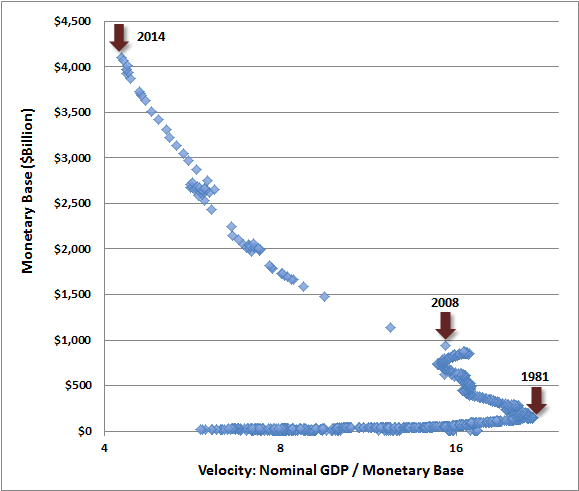
As you can clearly see, the velocity of money around the economy, which is a fundamental factor in real economic growth, is at historic lows. The relationship between the the zero-interest base money and the return potential made available by the higher interest investments is a primary driver in the velocity of money, and therefore, real economic growth.
Sadly, I doubt the Fed will choose to see or acknowledge this analysis enough to actually change course and perhaps aid the ailing economy that we find ourselves mired within.
The reason, John Hussman states, that quantitative easing and other currency-related manipulations are not more effective on the economy is that they do not increase the velocity of money flowing around the economy.
He states (in Losing Velocity: QE and the Massive Speculative Carry Trade):
From a monetary perspective, it’s easy to understand why replacing Treasury securities with zero-interest money (currency and bank reserves) does little to “stimulate” the economy. We may wish to believe that putting more zero-interest money into the economy would lead people to go out and spend those idle balances, but that imagines some fixed ratio between economic activity and the amount of money outstanding. That’s the error. The velocity of money (nominal GDP / monetary base) isn’t fixed at all. What happens in practice is that as the Fed creates more zero-interest money, holders try to get rid of it by buying financial assets that provide a higher potential return – driving prices up and expected future returns down until they are indifferent between an overpriced financial asset and zero-interest money. The closest alternative to currency is Treasury bills. So as the Fed creates more zero interest money, investors bid up Treasury bills, which lowers their interest rate. That’s how Fed actions move short-term yields.
He also has included several charts, one of which compellingly exhibits this truth, compiled from Federal Reserve data compiled over the past century (or so).As the central bank creates more money and interest rates move lower, people don’t suddenly go out and consume goods and services, they simply reach for yield in more and more speculative assets such as mortgage debt, and junk debt, and equities. Consumers don’t consume just because their assets have taken a different form. Businesses don’t invest just because their assets have taken a different form. The only activities that are stimulated by zero interest rates are those where interest rates are the primary cost of doing business: financial transactions.
As you can clearly see, the velocity of money around the economy, which is a fundamental factor in real economic growth, is at historic lows. The relationship between the the zero-interest base money and the return potential made available by the higher interest investments is a primary driver in the velocity of money, and therefore, real economic growth.
Sadly, I doubt the Fed will choose to see or acknowledge this analysis enough to actually change course and perhaps aid the ailing economy that we find ourselves mired within.
Friday, November 7, 2014
Capitalism Around the World

My friend Gega found this here:
http://www.tickld.com/x/capitalism-explained-this-is-so-accurate-it-hurts
No Commerce without Government Sanction: The People's Republic of San Francisco
In the fascist age of America, the government in San Francisco is now telling people how they can and cannot use their own private property when conducting safe and publicly amenable business. If I had the time and money, I would be inclined to purchase property there just to use it to break the law.
This is not Nazi Germany, fools, it is America. The government of San Francisco apparently doesn't see the distinction.
This is not Nazi Germany, fools, it is America. The government of San Francisco apparently doesn't see the distinction.
Thursday, October 30, 2014
Marin Katusa: The Colder War
John Mauldin sent forward a subset of a new book coming out by Marin Katusa regarding Vladimir Putin's rise to power and his plan for Russia.
As the section below indicates, Putin's primary hold on power is via control of the Russian and global energy markets. Putin is not one to be underestimated. He is a brilliant politician, and an extremely capable leader. He is the diametrical opposite of our current leader.
However, I imagine that even Putin did not see the hydraulic fracturing revolution coming, and I bet that it could very well be his undoing, if the U.S. has the foresight to capitalize on it before the technology is replicated elsewhere. Sadly, we are mired down in a self-defecating push for green energy, thereby probably passing on our one chance to slow Putin down.
Either way though, this book is exactly up my alley of interest and I am going to buy it. Besides, it is only 22 USD!
As the section below indicates, Putin's primary hold on power is via control of the Russian and global energy markets. Putin is not one to be underestimated. He is a brilliant politician, and an extremely capable leader. He is the diametrical opposite of our current leader.
However, I imagine that even Putin did not see the hydraulic fracturing revolution coming, and I bet that it could very well be his undoing, if the U.S. has the foresight to capitalize on it before the technology is replicated elsewhere. Sadly, we are mired down in a self-defecating push for green energy, thereby probably passing on our one chance to slow Putin down.
Either way though, this book is exactly up my alley of interest and I am going to buy it. Besides, it is only 22 USD!
GamerGate: What?
As a gamer and now a game developer, I have to say that this whole GamerGate nonsense, which I just learned about today, is absurdity.
If you are as clueless as I was about this yesterday, here is the most neutral source I could find when I was asking what happened: http://knowyourmeme.com/memes/events/gamergate
However, since I wish to reaffirm the ethical foundation of an art that I both support and engage in, I will say two things.
First, sending death threats to anyone is not a terribly civil way to live, and I condemn this behavior strongly. This is not how gamers behave and not how civil human beings behave. If you are pretending to be ISIS, stop it. It is not becoming of anyone in Western civilization to stoop to such barbary. And for the love of all that is good, if you are going to threaten someone with death, have the honor to do it face to face, not like some coward hiding behind the anonymity of the internet.
Second, sleeping around in general is not a good thing. Using that to gain advantage in a competitive capitalistic environment is equally unethical and deplorable. Sex is meant, by design, to be exercised in the structural confines of marriage between and man and a woman for the purposes of propagating the human race. It is shameful that people use each other in such a flippant fashion. It hurts everyone involved and it is disrespectful to do that to another person.
Sadly, we live in a corrupt and wicked world in which no one really cares one whit about anyone else and most people will use anyone to get what they want, when they want it. Any shreds of honor, civility, and humanity are gone from this age, which is ironic since those are the very principles that everyone loves to tout... God forbid if they should actually have to live by them.
If you are as clueless as I was about this yesterday, here is the most neutral source I could find when I was asking what happened: http://knowyourmeme.com/memes/events/gamergate
However, since I wish to reaffirm the ethical foundation of an art that I both support and engage in, I will say two things.
First, sending death threats to anyone is not a terribly civil way to live, and I condemn this behavior strongly. This is not how gamers behave and not how civil human beings behave. If you are pretending to be ISIS, stop it. It is not becoming of anyone in Western civilization to stoop to such barbary. And for the love of all that is good, if you are going to threaten someone with death, have the honor to do it face to face, not like some coward hiding behind the anonymity of the internet.
Second, sleeping around in general is not a good thing. Using that to gain advantage in a competitive capitalistic environment is equally unethical and deplorable. Sex is meant, by design, to be exercised in the structural confines of marriage between and man and a woman for the purposes of propagating the human race. It is shameful that people use each other in such a flippant fashion. It hurts everyone involved and it is disrespectful to do that to another person.
Sadly, we live in a corrupt and wicked world in which no one really cares one whit about anyone else and most people will use anyone to get what they want, when they want it. Any shreds of honor, civility, and humanity are gone from this age, which is ironic since those are the very principles that everyone loves to tout... God forbid if they should actually have to live by them.
Subscribe to:
Posts (Atom)